My son called while I was sitting on the porch of my Gulf Shores villa and said, “Megan’s parents live there now. It belongs to them, and you’re no longer welcome.” I smiled, packed one small bag, and let them arrive with a seventeen-foot U-Haul, new curtains, and plans to repaint the bedroom I had rebuilt with my own hands. What they didn’t know was that six years earlier, a retired judge had helped me prepare for the exact morning they tried to move in.
My name is Vivien Ivers. I’m sixty-seven years old, and three weeks ago, my only son tried to give away the house I built from the foundation up.
The call came at 4:17 on a Tuesday afternoon.
I was sitting on the white-oak porch swing, drinking sweet tea and watching pelicans dive into the Gulf. The water was turning copper beneath the setting sun when Derek’s name appeared on my phone.
He didn’t ask how I was.
“Mom, Megan’s parents lost their lease,” he said. “They’re going to live at the villa now.”
I set my book down.
“You’ve decided that?”
“It’s the right thing. You have your apartment in Mobile. You don’t need two places.”
“Derek, I built this house.”
He paused long enough for me to hear him choosing the words.
Then he said them.
“It belongs to them now. You’re not welcome there anymore.”
I looked at the Gulf.
I thought about the summer I tore out the rotten porch alone. The bathroom tile I laid with a torn rotator cuff. The reclaimed cypress cabinets I sanded until my fingers blistered.
Then I thought about a promise I made to my husband before he died.
“All right, sweetheart,” I said. “I understand.”
I hung up and called my attorney.
Twenty years earlier, the villa had been a condemned-looking cottage listed for $85,000.
The porch sagged. Raccoons lived in the attic. Mold covered the bathroom walls, and water stains spread across the ceilings like storm clouds.
Everyone saw a teardown.
I saw a home.
I bought it with my savings and the life-insurance money I had never touched after Arthur died.
Then I spent three summers rebuilding it.
I replaced the porch, repaired the foundation, framed two additional bedrooms, installed drywall, and took a weekend electrical course so I could help with the rough wiring.
My neighbor Tommy Guidry handled the work that required a licensed contractor, but my hands were on almost everything else.
By the third summer, the cottage had become a four-bedroom beach villa with a wraparound porch, gardenias along the back fence, and a swing I built from white oak.
Arthur and I had planned to build one together after retirement.
He never made it.
So I built it for both of us.
Every receipt went into a binder.
Every permit carried my name.
Every inspection report was saved.
I didn’t know then how important those papers would become.
Six years ago, Derek came to the villa carrying grocery-store carnations and a manila envelope.
He told me putting him on the deed would make things easier if I ever became sick.
“Dad would want me to have security,” he said.
Arthur’s voice returned to me immediately.
Never put the house in anyone else’s name. Not even Derek’s. People change when property is involved.
But my son was sitting across from me, asking me to trust him.
So I signed the quitclaim deed.
The moment he left, I felt sick.
I called my closest friend, Doris Palmer, a retired family-court judge.
“Has he recorded it?” she asked.
“I don’t know.”
“Find out tomorrow. Then put the villa into a living trust before anyone else makes a move.”
Derek never recorded the deed.
He put it in a drawer and assumed my signature was enough.
Within two weeks, the villa was legally transferred into the Vivien A. Ivers Revocable Living Trust.
Sole trustee: me.
Sole beneficiary: me.
I never told Derek.
For six years, that trust sat inside a safe-deposit box.
I prayed I would never need it.
Two weeks after Derek’s phone call, Megan’s father, Ray Proctor, arrived to inspect what he called his “new place.”
He walked through my kitchen opening cabinets and testing faucets. Then he sat in Arthur’s porch swing, put his boots on the railing, and opened a beer.
He called his wife on speakerphone.
“Donna, you’re going to love it. Four bedrooms, ocean view, wraparound porch. We hit the jackpot.”
Jackpot.
Like my life’s work was a prize he had scratched free from a lottery ticket.
I stood in the doorway taking photographs.
Ray lifted his beer toward me.
“Don’t worry about the dishes, Vivien. Donna’s bringing her own.”
The next day, Donna arrived with fabric samples and a tape measure.
She measured my bedroom windows and announced that the coral walls needed to be painted gray.
Then she found the old paint cans in the garage.
Seafoam.
Coral.
Driftwood.
The colors I had chosen while rebuilding the house.
“These are so dated,” she told Megan over speakerphone. “And the curtains smell like old lady. We’ll have to replace everything.”
I was standing six feet away.
She never noticed me.
A week later, Megan sat at my kitchen table and placed a photocopy of the old quitclaim deed in front of me.
“Derek took your name off the property six years ago,” she said. “My parents need the villa more than you do.”
I looked at my signature.
The document appeared official.
But an unrecorded deed is only paper.
“The right thing for the family,” Megan added.
“The right thing for which family?” I asked.
“The family that needs it most.”
I nodded.
“I’m glad we understand each other.”
She walked away believing she had shown me proof that the villa belonged to Derek.
What she had actually shown me was proof that they had built their entire plan around a document with no legal force.
While the Proctors replaced my curtains and painted my walls, I met with Tommy.
He still had copies of every construction permit, material invoice, and inspection report from the renovation.
We built two binders.
Purchase price: $85,000.
Renovation costs: $247,000.
Twenty years of taxes and insurance: another $120,000.
More than $450,000 invested through my labor, my income, and Arthur’s final gift to me.
Then my attorney discovered Derek had listed the villa as his personal asset on a loan application.
That changed everything.
He hadn’t merely lied to Megan’s parents.
He had used property he didn’t own to obtain credit.
The move-in was scheduled for Saturday.
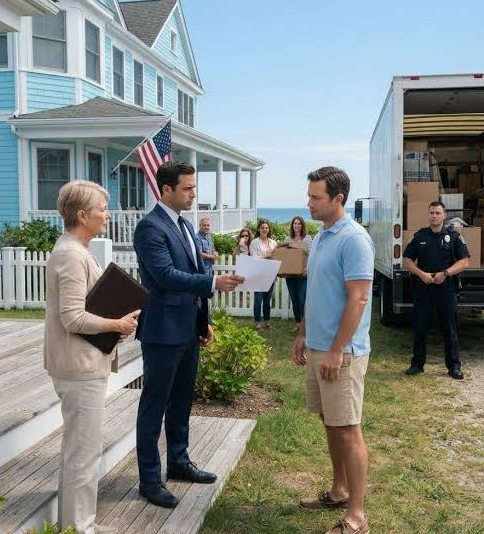
Ray and Donna terminated their lease. They rented a seventeen-foot U-Haul and invited friends to help unload.
They told the neighborhood they had inherited the property.
I let them believe it.
Saturday morning, the U-Haul pulled into my driveway at 7:30.
By eight, furniture covered the lawn. Boxes labeled “Master Bedroom” and “Kitchen” were stacked beside Arthur’s swing.
Ray’s friends arrived with dollies and coolers.
Donna wore a new yellow sundress.
Derek and Megan pulled up at 8:15.
Neighbors gathered along the street to welcome the supposed new owners.
At 8:52, Tommy texted me.
“They’re all here.”
I was parked at a gas station off Highway 59, wearing pressed khakis and a white linen blouse.
A manila folder rested on the passenger seat.
“I’ll be there at nine,” I replied.
At exactly nine o’clock, I turned onto Gulf Shore Drive and parked behind the U-Haul.
Derek saw me step from the truck.
His face changed immediately.
“Mom, what are you doing here?”
I looked past him at the boxes, the furniture, and the people standing on the porch I had rebuilt board by board.
“Good morning, Derek,” I said. “I live here.”
Then a Baldwin County sheriff’s cruiser turned into the cul-de-sac behind me, its lights rotating slowly.
A silver Lexus followed.
My attorney stepped out carrying the trust documents.
Ray lowered the box in his hands.
Megan stopped smiling.
And when the deputy walked toward my porch, Derek looked at the folder beneath my arm and finally realized I had never surrendered anything at